
Radon Testing When Buying a Home in Dutchess County, NY: What Buyers Need to Know
 Should you test for radon when buying a home in Dutchess County, NY?
Yes. The New York State Department of Health recommends testing every home, and state kit data show about 53% of Dutchess County basement tests at or above the 4 pCi/L fix level. Order a certified test of at least 48 hours during your due diligence period.
You found a colonial in Wappingers Falls, a farmhouse near Rhinebeck or a ranch in Pleasant Valley, and the inspection report is the next hurdle. Most buyers expect the roof, the furnace and the foundation to get attention. Radon is the item that gets skipped, even though it is invisible, odorless and tied to the home's lowest level, which many buyers plan to finish or use.
This guide explains what radon testing involves for Dutchess County home buyers, how to read results, what the seller must disclose under New York law, and what a fix typically involves. It is general information, not legal or health advice, so confirm details with your attorney and a certified professional.
If you are new to buying, start with our complete home buying guide for first time buyers. If you are looking at an older Hudson Valley property, our guide to buying a historic home in Dutchess County covers another due diligence item that applies to those homes.
Why Radon Testing Matters for Dutchess County Home Buyers
The state's test data shows high readings are common here
The New York State Department of Health publishes radon kit results by town in its Radon Test Results by Town dataset. Adding up the Dutchess County rows, 1,827 of 3,428 basement tests (53%) and 281 of 1,187 first floor tests (24%) read 4 pCi/L or higher. The state notes that these are screening kit results, that some locations have few results, and that the best indication for a particular home is to test that home. Treat the figures as a guide to the region, not a prediction for any one house.
Results vary by town. Here is a sample of the state's Dutchess County figures, showing the share of tests at or above 4 pCi/L.
| Town or city | Basement tests | Basement at or above 4 | First floor at or above 4 |
|---|---|---|---|
| Wappinger | 146 | 36% | 15% |
| Beacon | 73 | 37% | 11% |
| Fishkill | 145 | 39% | 10% |
| Red Hook | 200 | 45% | 19% |
| Poughkeepsie (city and town combined) | 1,128 | 48% | 17% |
| East Fishkill | 390 | 57% | 25% |
| Hyde Park | 237 | 60% | 16% |
| Rhinebeck | 140 | 62% | 21% |
| Pleasant Valley | 146 | 62% | 41% |
| Pine Plains | 45 | 76% | 48% |
Even the lowest basement share in this sample, Wappinger at 36%, means more than one in three tested basements was at or above the fix level. Small samples, like the 45 basement tests in Pine Plains, call for extra caution. A low town average does not clear an individual house, so every Dutchess County purchase deserves a test.
Winter is a good time to test
The New York State Department of Health radon page advises testing during the winter months and keeping outside doors and windows closed for 24 hours before and during a test. If you are under contract in Dutchess County this season, heating weather works in your favor for a representative reading. Our seasonal winterizing checklist covers the rest of your cold weather home preparation.
What the Results Mean: 4 pCi/L and the Gray Zone
Radon is measured in picocuries per liter of air, written pCi/L. The New York State Department of Health recommends fixing a home at 4 pCi/L or higher. It also says that fixing may be worth considering between 2 and 4 pCi/L, and that levels can usually be brought to 2 pCi/L or below. The EPA gives the same guidance in its radon guide for home buyers.
The Department of Health states that radon is the leading cause of lung cancer among nonsmokers, so a high result deserves a real conversation with your attorney and not a minor note on a report.
How a Radon Test Works During a Home Purchase
Use a certified tester and an approved lab
For a purchase, the state advises hiring a certified radon testing professional and confirming that the lab is approved through New York's Environmental Laboratory Approval Program. The state also sells homeowner kits for $12.25 including lab analysis, which suit testing a home you already own.
Test the lowest level you could use as living space
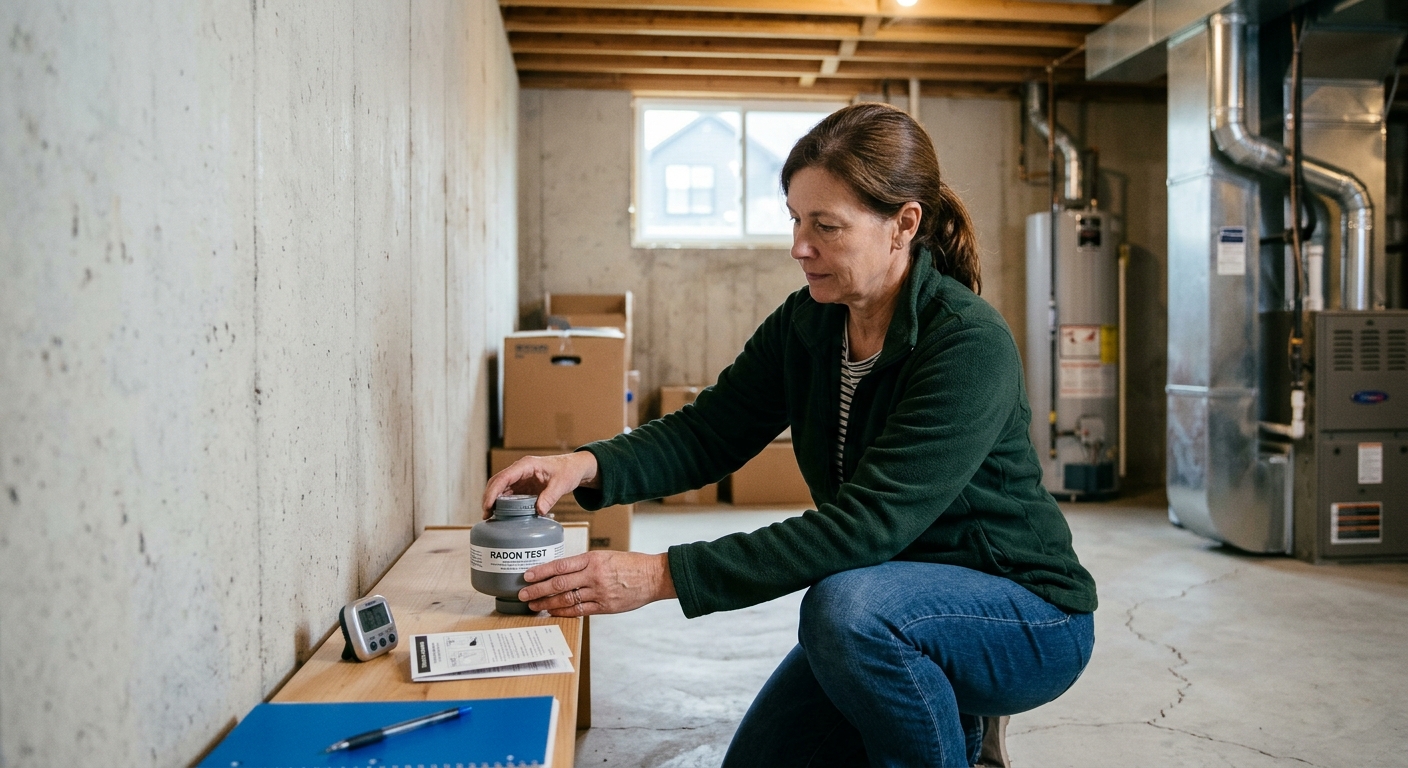
According to the EPA guide, buyers should test the lowest level that could regularly serve as living space, finished or not, because you may use a basement differently than the seller did. Devices should sit at least 20 inches off the floor, away from drafts, exterior walls and humid rooms like kitchens, bathrooms and laundry rooms, and should not be disturbed during the test.
Closed house conditions and test length
The EPA says every test should run at least 48 hours, and that windows and exterior doors should stay closed except for normal entry and exit. For tests shorter than four days, closed house conditions should begin at least 12 hours before the test. This is why you should schedule the test early in your inspection window, since results can take additional days.
Three accepted short term options
For real estate transactions, the EPA lists three accepted short term options: two passive tests run at the same time, two passive tests run one after another, or one continuous monitor run for at least 48 hours. In each case, the guide says to fix the home if the average is 4 pCi/L or higher. Testers can also use motion detectors, pressure and temperature logs or tamper resistant window seals to guard against interference.
Radon and the New York Property Condition Disclosure Statement
New York's Real Property Law Section 462 requires sellers of covered residential property to complete and sign a Property Condition Disclosure Statement and deliver it to the buyer or the buyer's agent before the buyer signs a binding contract. Question 24 on the form asks whether a radon test has been done and, if so, asks the seller to attach the report. The form is a statement of what the seller knows, and it does not replace your own testing. Our guide to the New York property condition disclosure and flood questions explains how the same form works from the seller's side.
How to review a seller's earlier test
If the seller provides a radon report, the EPA guide suggests checking who ran the test, where in the home it was placed, when it took place, and whether any renovations or heating and cooling changes have happened since. An older report from a different season or a different room may not reflect the home you are buying. Ask your attorney whether to order a fresh test.
If the Result Is High: Fixing Radon in a Dutchess County Home
A high radon result does not have to end a deal. The state says a radon reduction system can lower levels by up to 99%, and puts the average cost at about $2,500. Your quote will depend on the home, so get several estimates. The EPA explains that the most common method is a vent pipe and fan that draw soil gas from beneath the foundation and release it outdoors, and that sealing cracks alone is not considered an effective fix.
The state's guide for residents says systems should be installed by a certified radon mitigator. After installation, retest to confirm the system works. The state advises retesting within 30 days of installing a system, again every two years for homes with a system, and every five years for homes without one.
How buyers handle a high result
Ask your New York real estate attorney how to address it under your contract, such as a repair before closing, a price credit or a negotiated timeline. Get more than one estimate from certified mitigators and make sure the contract covers a post installation test. Radon is not the only hidden system on a rural property. Our guide to buying a home with a septic system in Putnam County covers another item that deserves a test, though its county health department rules are specific to Putnam County.
A Radon Checklist for Dutchess County Buyers
- Add radon to your inspection plan. Order the test the same week as your general inspection.
- Hire a certified tester. Confirm the lab is approved by the state.
- Test the lowest usable level. Include a basement you plan to finish.
- Maintain closed house conditions. Ask the sellers to cooperate for the full test.
- Read the disclosure form. Check Question 24 and any attached report.
- Know your number. Fix at 4 pCi/L or higher, and consider it between 2 and 4.
- Plan the retest. If a system is installed, test again to confirm.
Frequently Asked Questions About Radon Testing in Dutchess County, NY
Is radon testing required when buying a home in Dutchess County?
No law requires a buyer to test, but the New York State Department of Health recommends testing every home, and the seller's disclosure form asks whether a test has been done. Many buyers add radon to the inspection contingency.
How common is high radon in Dutchess County?
The state's kit data show 53% of Dutchess County basement tests and 24% of first floor tests at or above 4 pCi/L. Basement shares range from about 36% in Wappinger to more than 75% in Pine Plains and Amenia, though small samples in some towns call for caution.
What radon level is too high?
The state and the EPA recommend fixing a home at 4 pCi/L or higher. Levels between 2 and 4 pCi/L may also be worth fixing, since any exposure carries some risk.
How long does a radon test take during a home purchase?
At least 48 hours, with windows and exterior doors kept closed, and some devices need longer. Schedule it early so lab results arrive before your contract deadlines.
Where in the house should the test go?
Place it in the lowest level that could regularly serve as living space, such as a basement you may finish. Avoid closets, stairways, hallways, crawlspaces and humid rooms.
How much does a radon system cost?
The New York State Department of Health puts the average cost of a radon reduction system at about $2,500. Quotes vary by home, so get several estimates from certified mitigators.
Does the seller have to disclose radon in New York?
The Property Condition Disclosure Statement asks whether a radon test has been done and asks the seller to attach the report if so. The seller must deliver the form before the buyer signs a binding contract.
Can a high radon result be negotiated?
Yes. Buyers commonly ask for a repair, a credit or more time, depending on the contract. Ask your New York real estate attorney how to structure the request. If you are the seller, read our tips on selling a home as is before you decide how to respond.
Talk to a Local Expert
Steven Scarnati, a licensed real estate salesperson with Real Broker NY LLC, helps buyers and sellers across Dutchess County, Westchester County, Putnam County and Fairfield County, CT. If you are comparing homes in the Hudson Valley, he can help you build an inspection plan and a timeline that protects you before you make an offer. Reach him at stevescarnatihomes@gmail.com or (845) 661-3469.
Schedule a consultation with Steve Scarnati.
This article is general information, not legal, health or financial advice. Rules, forms and requirements change, and your property may differ. Consult a New York real estate attorney, a certified radon professional and the New York State Department of Health about your own purchase.
Categories
Recent Posts